The problem: every website says "trusted", "secure" and "verified". Customers cannot tell which ones mean it — and now AI assistants such as ChatGPT and Gemini must decide which sources to cite and which businesses to recommend. A self-declared trust claim proves nothing. A score that anyone can verify does.
That is the idea behind the Web Credibility Score (WCS) from Alert91, the website-monitoring platform built by the team at 91Technologies. This article explains in plain language what WCS measures, how the number is calculated, how the grades work and what you can do today to raise your own score.
What is the Web Credibility Score?
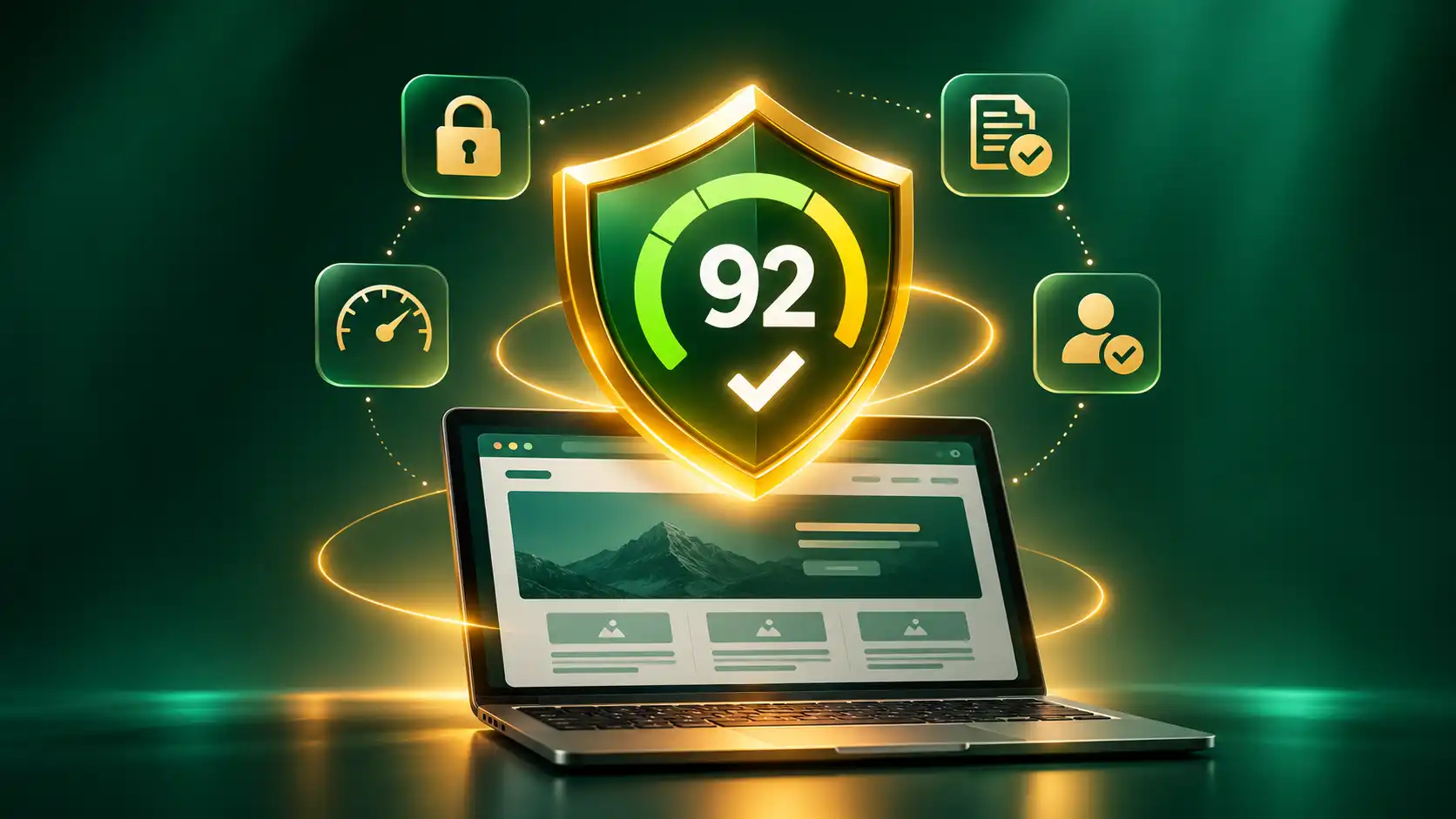
WCS is a single 0–100 score that blends two things:
- a 60+ check automated technical audit, grouped into seven weighted sub-indices; and
- manual, human verification of the business behind the website — its email, phone, legal name, address, GST and registration.
The published formula (methodology version 2.0, June 2026) is:
WCS = Technical audit × 70% + Manual verification × 30%
Alert91 stresses that the score is a deterministic, rule-based model, not a machine-learning opinion: each point on the scale traces back to a specific check with a fixed, published weight. That matters for fairness — two auditors, or two scans, should reach the same answer.
The seven technical sub-indices
The 70% technical part is itself a weighted blend of seven indices, each scored 0–100:
| Index | Weight in the technical score | What it looks at |
|---|---|---|
| Security (SI) | 25% | HTTPS, HSTS, Content Security Policy, X-Frame-Options, SPF and DMARC email records, exposed sensitive files, risky open ports, TLS version, unrecognised new third-party scripts |
| AI Credibility (ACI) | 20% | llms.txt, structured data (Schema.org), FAQ schema, AI crawlers not blocked, question-style headings, "sameAs" social profiles, last-modified dates |
| Digital Trust (DTI) | 15% | Domain age, About page, named authors, review markup, social links, and a visible phone number, email and office address |
| Performance (PI) | 15% | 30-day uptime of 99% or better, response time, Largest Contentful Paint (≤ 2.5 s), Cumulative Layout Shift (≤ 0.1), mobile viewport |
| Compliance (CS) | 10% | Privacy Policy, Terms, cookie consent, India's DPDP Act 2023 signals, refund policy, GSTIN, grievance officer, company registration |
| Accessibility (AS) | 10% | Language attribute, page titles, image alt text, skip link, landmarks, form labels |
| Reputation (RI) | 5% | Google Safe Browsing, blacklists, external reviews, verified social profiles, recent brand mentions |
Two things stand out. First, security carries the biggest weight — a site that cannot protect visitors cannot be called credible. Second, a surprising share of the score (AI-readiness, compliance, accessibility) rewards basic professionalism that many sites simply skip.
The 30% that machines cannot fake: manual verification
This is what separates WCS from a typical automated "website grader". A reviewer checks, among other things:
- that the business email is on the company's own domain (not Gmail or Yahoo) — the single biggest item;
- the phone number, legal company name and business address;
- the GST registration against the company name;
- Google Business reviews; and
- company registration (CIN, MSME or PAN).
A high technical score on its own does not qualify a site for the badge — a person has to confirm the business is real.
Grades, caps and certification tiers
| Score | Grade | Label |
|---|---|---|
| 90–100 | A+ | Highly Credible |
| 80–89 | A | Credible |
| 70–79 | B | Generally Credible |
| 55–69 | C | Needs Improvement |
| 40–54 | D | Low Credibility |
| 0–39 | F | Not Credible |
Kill-switch caps apply after scoring: a site without HTTPS cannot score above 39 (F), and a site with neither a Privacy Policy nor Terms cannot score above 54 (D) — however good everything else is.
Certification tiers: without a verified company-domain email a site stays at "Basic"; with it, "Verified"; and a blended score of 85 or more with full manual verification earns "Certified". The certificate is valid for 12 months, after which a re-audit is required. The badge is issued only at the Verified or Certified level.
Extra signals: confidence, momentum and industry score
- Confidence level (Low to Very High) shows how much monitoring data sits behind the score — a site with uptime history, real-user performance data, security audits and a long domain age earns "Very High".
- Trust Momentum shows whether credibility is improving, stable or declining over time, for example "+16 points in 3 days" after fixes.
- Industry-Specific Trust Score is a separate 0–100 score that does not change the main WCS. It checks sector essentials: FSSAI licence and menu for food businesses, doctor credentials and NMC/NABH registration for healthcare, return and shipping policy for e-commerce, status page and changelog for SaaS.
The badge and public verification
Once certified, you add a single line before the closing footer tag:
<script src="https://monitor.alert91.com/wcs-badge.js?domain=yourdomain.com"></script>
The "WCS Compliant" badge then appears automatically on WordPress, Webflow or any HTML site. It links to a public page (verify.alert91.com/yourdomain.com) where a visitor can see the score, grade and tier — so the claim can be checked, not just believed. A public verification API also exists, and it only returns domains that are Verified or Certified.
What does it cost?
WCS certification is a paid service, because it includes human verification. At the time of writing the launch price is ₹2,999 per website for 12 months (plus GST). You can begin with a ₹199 advance that counts towards the price, see your automated score and areas to fix, and pay the balance only if you continue to verification. If a site does not qualify, one free re-audit is available within 30 days after fixing the issues. Prices can change, so confirm on alert91.com/wcs.
Why this matters now
- Customers hesitate to pay unknown websites. A verifiable badge reduces that doubt, especially for newer brands.
- AI search rewards machine-readable credibility. Files like
llms.txt, clean structured data, FAQ markup and clear authorship help AI systems understand and cite you. - Compliance is becoming visible. With India's DPDP Act 2023, a clear privacy policy, consent banner and grievance officer are no longer optional extras.
- Links alone are not enough. Backlink-based authority can be bought; verified identity and security cannot.
A 10-point checklist to raise your score today
- Serve everything over HTTPS and add HSTS, a Content Security Policy and X-Frame-Options headers.
- Publish SPF and DMARC records for your email domain.
- Add a clear Privacy Policy, Terms, refund policy and cookie banner.
- Show your phone number, business email and office address on the site.
- Use an email address on your own domain, not Gmail.
- Add an About page and named authors on articles.
- Publish structured data (Organisation, FAQ) and an
llms.txtfile; do not block AI crawlers unless you intend to. - Give every image alt text and every form field a label.
- Fix slow pages: aim for LCP under 2.5 seconds and CLS under 0.1.
- Keep uptime above 99% — monitor it, so you hear about downtime before customers do.
Most of these are straightforward for a developer to implement; they also improve your SEO and conversion rate, so the effort pays back even before you certify.
Check your site
You can see how your website scores and get a fix list at alert91.com/wcs. If you would like help fixing what the audit finds — security headers, compliance pages, performance, structured data — the team at 91Technologies can do it for you. Get in touch.
Disclosure: Alert91 is a product of 91Technologies. Details in this article come from Alert91's published WCS page and methodology (v2.0, June 2026), read on 15 November 2026. Pricing and scoring rules may change.